Persoonallisuuden ulottuvuudet
Mindfindr offers the respondent a personality description based on a combination of scientifically valid universal personality dimensions. The results report may include two descriptions when the scores on some of the dimensions are balanced.
When interpreting the results it is noteworthy that the combinations of the dimensions are more important with respect to understanding a person’s behavior than any one personality dimension considered individually.
Persoonallisuuden ulottuvuudet voidaan kuvailla seuraavasti:
Tiedonkäsittelyn ulottuvuus kuvaa henkilön mieltymyksiä tiedon havaitsemisessa, keräämisessä, analysoinnissa ja käytössä. Asteikon vasemmalla puolella olevat henkilöt ovat yleensä käytännöllisempiä, kiinnittäen huomiota konkreettisiin yksityiskohtiin. Asteikon oikealla puolella olevat ovat avoimempia kokemuksille, toimien abstraktien käsitteiden ja tulevaisuuden mahdollisuuksien varassa. Vaikka asteikon vasemmalle puolelle sijoittuvat luottavat enemmän viiteen aistiinsa ja ovat yleensä perinteisempiä havainnoissaan, oikealle sijoittuvat ovat yleensä luovia, etsien uusia innovatiivisia näkökulmia ongelmiin.
Aktiivisuuden ja sosiaalisuuden ulottuvuus kuvaa henkilön tyypillisiä sosiaalisen vuorovaikutuksen tapoja sekä aktiivisuuden ja elämysten hakemisen tasoja. Asteikon vasemmalle puolelle sijoittuvia voidaan kuvata ekstroverteiksi, ulospäinsuuntautuneiksi, sosiaalisesti rohkeiksi henkilöiksi, joilla on vahva sosiaalinen läsnäolo ja jotka yleensä vaikuttavat muihin. Asteikon oikealla puolella olevat pisteet viittaavat siihen, että nämä henkilöt ovat pikemminkin introvertejä, jopa etäisiä, ja he pystyvät usein keskittymään työhönsä pitkiä aikoja. Missä ekstrovertit ovat joskus kärsimättömiä ja nopeita päättäjiä, introvertit saattavat tarvita enemmän aikaa päätösten tekemiseen ja muihin tutustumiseen.
Päätöksenteon perusteet vaikuttavat eri tavalla siihen, miten ihmiset reagoivat asioihin, tekevät johtopäätöksiä ja tekevät päätöksiä, erityisesti uusissa tilanteissa. Vasemmalla olevat ovat yleensä liiketoimintamaisia, loogisia ja objektiivisia tehdessään päätöksiä. Toisaalta keskikohdan oikealla puolella olevat ihmiset ovat tunteellisempia ja punnitsevat omia ja muiden arvoja ja tunteita tehdessään päätöksiä. Vasemmalla olevat saattavat joskus vaikuttaa etäisiltä ja viileiltä, kun taas oikealla olevat ovat yleensä ystävällisiä ja lämpimiä sosiaalisessa vuorovaikutuksessa.
Toimintatapa viittaa vastaajien tyypillisen käyttäytymisen organisoitumisen ja sopeutumiskyvyn tasoon. Ulottuvuuden vasemmalla puolella olevat henkilöt ovat yleensä järjestelmällisempiä, tunnollisempia ja suunnitelmallisempia verrattuna oikealla oleviin, jotka ovat yleensä sopeutuvampia ja joustavampia, pitäen vaihtoehtonsa avoimina uusissa tilanteissa. Vasemmalla olevat tuntevat olonsa kotoisammaksi ennustettavissa ympäristöissä ja rutiinitehtävien parissa, arvostaen usein suuresti turvallisia olosuhteita. Oikealla olevat saattavat helpommin kyllästyä rutiineihin ja saattavat joskus joutua kamppailemaan tehtävien suorittamisessa ja aikarajoissa pysymisessä.
These four dimensions combined describe a person’s typical behavioral modes. Scores in the middle of a continuum mean that the mode of conduct changes somewhat with the type of environments and situations. For these persons Mindfindr produces two different personality descriptions.
Combining these basic personality dimensions yields psychological types that describe behavior more comprehensively. In psychology, as in other sciences, it is important to categorize findings so as to produce more abstract and generalizable knowledge to further understanding of the studied phenomena. However, we must at all times remember that the persons having taken any psychological test will be much more as individuals than what the test results bring up. Mindfindr offers respondents wider perspectives on their behavior by providing work style, teamwork style and leadership descriptions.
A personality description produced by Mindfindr focuses on such personality traits of the assessed that are considered relevant to work performance.
Personality type encompasses an individual’s unique blend of four dimensions: thinking and feeling, extraversion and introversion, organization and flexibility and concreteness and abstraction. These dimensions shape an individual’s distinctive psychological makeup, influencing their characteristics- and behavioral patterns.
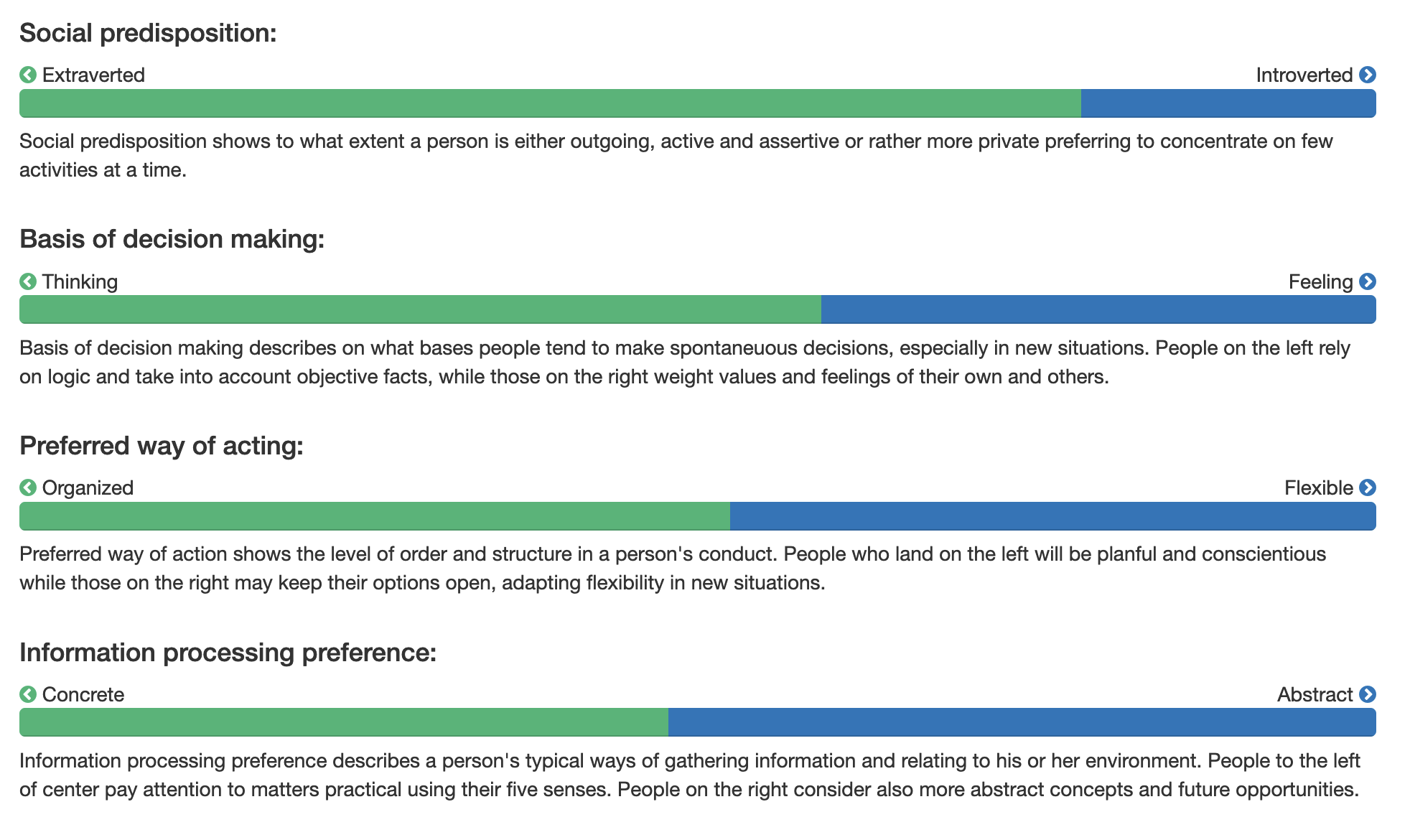
Understanding a participant’s personality type can provide insights into how they perceive the world, interact with others, and approach various aspects of their personal and professional life.
Basis of decision making (Thinking - Feeling)
Basis of decision making describes on what basis people tend to make spontaneous decisions, especially in new situations. People on the left rely on logic and take into account objective facts, while those on the right weigh values and feelings of their own and others.
Case #1: Developing a new sales process.
Emily and David are both sales managers at a retail company tasked with developing a new sales process to improve customer engagement and increase sales revenue. Emily tends to rely on logic and objective facts in decision-making, while David prioritizes personal values and emotions.
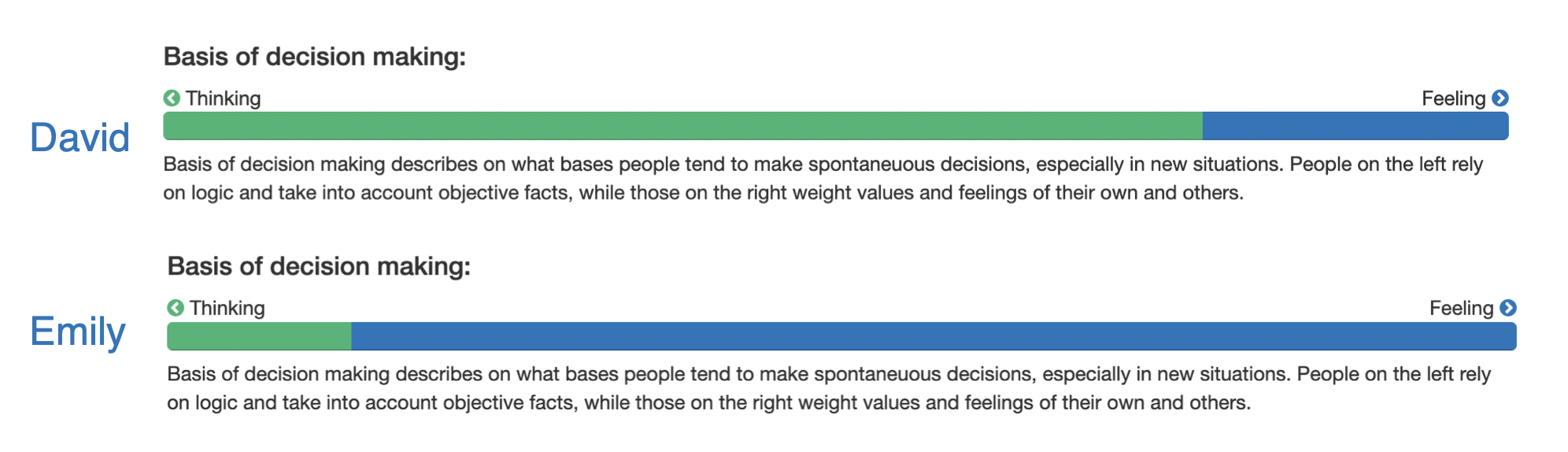
Emily, approaching the task from a left-leaning perspective, begins by conducting thorough market research to identify trends, customer preferences, and competitor strategies. She analyzes data related to sales metrics, customer feedback, and industry benchmarks to inform her decision-making process. Emily focuses on creating a structured sales process based on logical steps, measurable objectives, and performance indicators.
In contrast, David, who leans towards the right in decision-making, places a greater emphasis on the human aspect of the sales process. He values building strong relationships with customers and believes in tailoring the sales approach to meet individual needs and preferences. David engages with sales team members to understand their experiences and gather insights into customer interactions. He prioritizes empathy, trust, and rapport-building in the development of the sales process, considering how each step aligns with the company’s values and fosters positive customer experiences.
In this case, Emily’s left-leaning approach to decision-making emphasizes data-driven analysis and logical reasoning to develop a structured sales process. Meanwhile, David’s right-leaning approach incorporates personal values, emotions, and interpersonal dynamics to create a sales process focused on building relationships and meeting customer needs. Both approaches offer unique perspectives and considerations that contribute to the development of an effective sales strategy.
Social predisposition (Extraverted - Introverted)
Social predisposition shows to what extent a person is either outgoing, active and assertive or rather more private preferring to concentrate on few activities at a time.
Case #2: Organizing a network event.
Sarah and Michael are both marketing managers at a large advertising agency. They have been assigned to lead a team tasked with organizing a high-profile networking event for clients and industry partners. Sarah is an extrovert, while Michael is an introvert, and their differing social predispositions influence their approaches to the task.
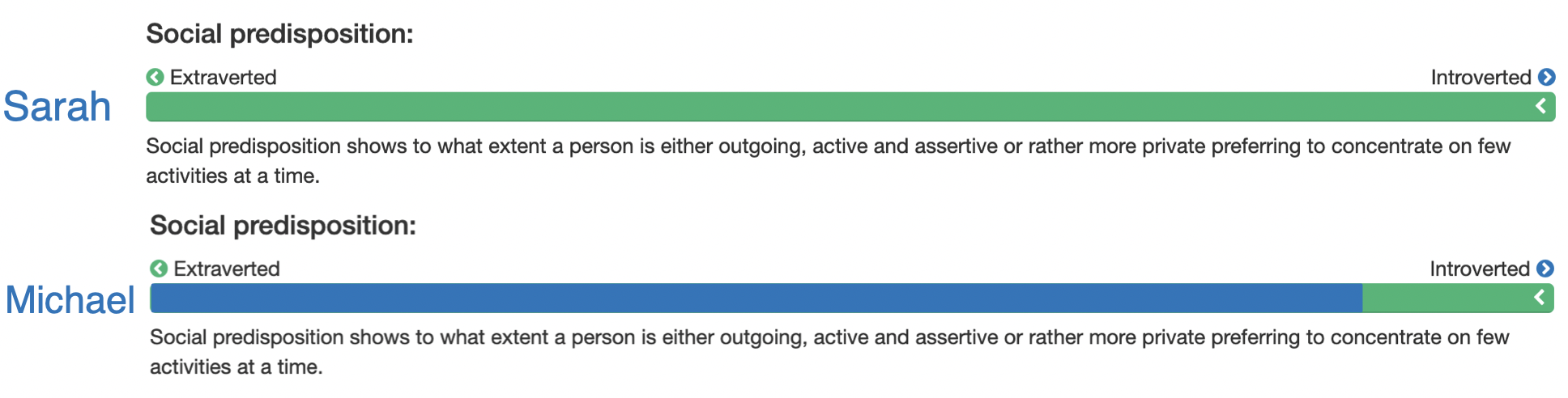
Sarah, the extrovert, thrives in social settings and enjoys networking and engaging with others. She approaches the event planning with enthusiasm, immediately reaching out to potential attendees, networking contacts, and sponsors. Sarah suggests hosting a large-scale event with interactive activities, lively entertainment, and opportunities for spontaneous connections. She prefers to involve a broad range of stakeholders and encourages brainstorming sessions with the team to generate creative ideas.
On the other hand, Michael, the introvert, prefers a more private and focused approach to social interactions. He carefully considers the event’s objectives and suggests a smaller, more intimate gathering focused on building meaningful connections with key clients and partners. Michael emphasizes the importance of quality over quantity, proposing structured networking sessions and targeted discussions to facilitate deeper engagement. He prefers to concentrate on a few activities at a time, ensuring thorough planning and attention to detail.
In this example, Sarah’s extraverted nature leads her to embrace the social aspect of event planning, focusing on creating a dynamic and expansive networking experience. In contrast, Michael’s introverted disposition influences him to prioritize a more focused and intimate approach, emphasizing meaningful connections and thoughtful interaction. Both Sarah and Michael bring valuable perspectives to the team, demonstrating how social predispositions can influence individuals’ preferences and strategies in collaborative settings.
Preferred way of action (Organized - Flexible)
Preferred way of action shows the level of order and structure in a person’s conduct. People who land on the left will be planful and conscientious while those on the right may keep their options open, adapting flexibility in new situations.
Case #3: Launching a new product line.
Rachel and Alex are both project managers at a design firm, and they have been assigned to lead a team in launching a new product line. Rachel leans towards the left on the organized and flexible spectrum, while Alex tends towards the right.
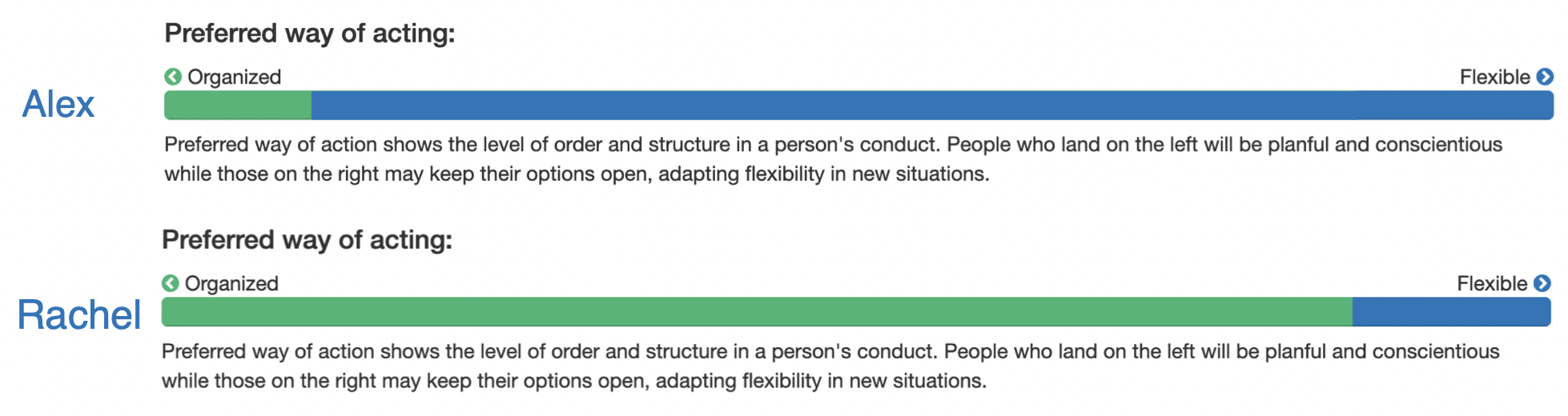
Rachel, the organized planner, approaches the project with a detailed timeline, clear milestones, and a structured plan. She schedules regular team meetings, assigns specific tasks to each team member, and sets deadlines to ensure progress is on track. Rachel’s meticulous approach ensures that everyone knows their role and responsibilities, and she prefers to stick to the established plan to maintain order and efficiency.
On the other hand, Alex, the flexible adapter, takes a more fluid approach to project management. He keeps his options open and adapts quickly to new information or unexpected challenges. Rather than following a rigid plan, Alex encourages team members to brainstorm and explore different ideas collaboratively. He remains open to making changes on the fly and is willing to pivot strategies as needed to respond to evolving circumstances.
As the project progresses, Rachel’s structured approach helps keep the team organized and focused, ensuring that tasks are completed according to schedule. However, when unexpected issues arise, she may struggle to deviate from the original plan. In contrast, Alex’s flexible mindset allows him to adapt quickly to changes, enabling the team to pivot strategies and find creative solutions to problems as they arise.
In this example, Rachel’s preference for organization and structure provides stability and clarity, while Alex’s flexibility allows for innovation and adaptability in the face of uncertainty. Both approaches have their strengths and weaknesses, demonstrating how individuals’ preferred ways of action can impact their effectiveness in different situations.
Information processing preference (Concrete – Abstract)
Information processing preference describes a person’s typical ways of gathering information and relating to his or her environment. People to the left of center pay attention to matters practical using their five senses. People on the right also consider more abstract concepts and future opportunities.
Case #4: Developing a new advertising campaign
At a marketing agency, two creative directors, Emily and Jake, are tasked with developing a new advertising campaign for a client in the fashion industry. Emily leans towards the concrete end of the spectrum, while Jake leans towards the abstract.
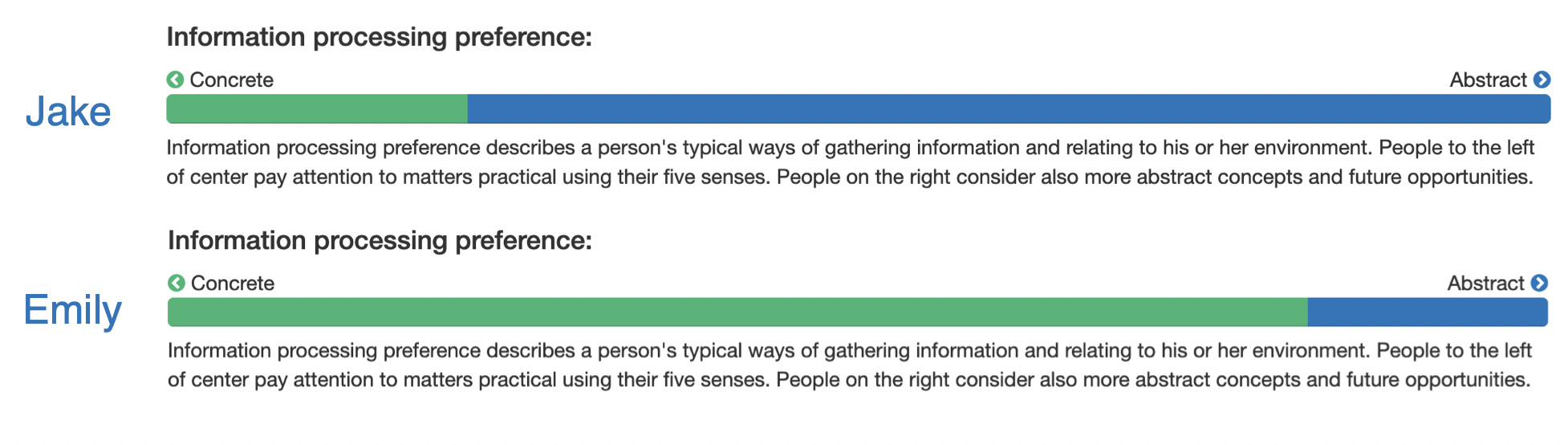
Emily, with a preference for concrete information processing, focuses on tangible aspects of the campaign. She pays close attention to practical details such as color schemes, imagery, and product features. Emily conducts thorough market research to understand current consumer trends and preferences, relying on data-driven insights to inform her creative decisions. She emphasizes the importance of creating visually appealing and relatable content that resonates with the target audience on a sensory level.
On the other hand, Jake, with a preference for abstract thinking, approaches the campaign from a more visionary perspective. He considers broader concepts such as brand identity, storytelling, and emotional resonance. Jake is interested in exploring innovative ideas and pushing creative boundaries to evoke deeper connections with consumers. He envisions the campaign as an opportunity to communicate the client’s values and aspirations, transcending traditional advertising approaches to create a memorable and impactful brand experience.
While Emily’s concrete approach ensures a solid foundation grounded in practical considerations, Jake’s abstract perspective adds a layer of creativity and forward-thinking vision to the campaign. Together, their complementary styles result in a well-rounded advertising strategy that balances tangible elements with conceptual depth, effectively engaging consumers and achieving the client’s objectives. This case exemplifies how individuals with different information processing preferences can collaborate to create innovative solutions that appeal to diverse audiences and drive success in the competitive marketplace.